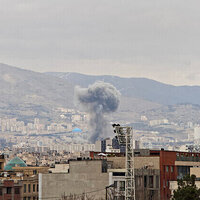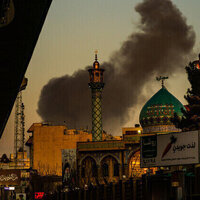


I am devastated for families in Iran whose daughters left for school and did not return home.
For parents in Gaza who buried their children beneath the rubble of their classrooms.
For Afghan girls living under the brutal Taliban regime for nearly five years.
You will be hearing a lot this week about “access to justice.”
But true justice does not defend the humanity of children in one place and ignore it in another. It is not selectively applied. It does not claim that our rights are dependent on where we were born or what is politically safe for the people in this room.
Under international law, killing children in their classrooms is a war crime. When civilians are deprived of food, water, medicine and shelter, the law obligates states to act. Looking around the world today, we must ask ourselves why justice is a privilege extended to some and withheld from others — why it is not wide enough to reach girls in Minab, Jabalia or Kandahar.
Globally, we are witnessing a backlash against women’s rights — rights that took generations to gain. Nowhere is that more evident than Afghanistan.
Since the Taliban took over the country in 2021, they have controlled courts, the police and public institutions. And they have used their power to abuse women and girls. Girls cannot go to secondary school or university. Women cannot go to work, leave their homes without a male chaperone or even speak in public. The list goes on and on: no sports, no nail polish, no singing or reciting poetry. Women and girls cannot be treated by a male doctor and are not allowed to train to become doctors themselves.
In Afghanistan today, it is legal for a man to beat his wife or daughter. I recently spoke on the phone with an Afghan girl. When I go to my room and read a book, she said, it feels like I am defying the Taliban. She is one of millions for whom simply existing has become an act of courage. For nearly five years, the Taliban have been erasing women and girls from public life. And the world has responded by looking away. Or by excusing these abuses under the banners of “culture” and “religion.”
This is not culture. It is not religion. It is a system of segregation and domination. We must call the regime in Afghanistan by its true name: gender apartheid.
And we must explicitly recognize it as a crime under international law. By codifying gender apartheid, we can protect women and girls and prevent these atrocities from happening to another generation. It is not enough to grieve for those who are suffering — we must move from sympathy to accountability. Afghan women are not asking for military intervention. They are not asking to be saved. They are asking for recognition in law so that the long work of justice can begin.
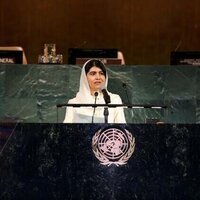
So I ask the Member States in this room: How long will you allow the law to stand still while injustice evolves? Thirteen years ago, I believed that speaking in this hall would be enough.
Today I know that speeches do not protect girls.
But law, accountability and political courage can. You have all three within your reach. Now is the time to use them.