

New posts
23:08
Mojtaba Khamenei Follows In Father's Footsteps As Iran's New Supreme Leader
The March 8 election of Mojtaba Khamenei as the new leader by Iran's Assembly of Experts following the killing of Ayatollah Ali Khamenei in a US-Israeli attack marks the first time the son of a supreme leader is succeeding his father in the Islamic republic.
Mojtaba Khamenei has rarely appeared in public and has never addressed an audience beyond seminary classrooms, yet he is widely seen as a shadowy behind-the-scenes force with influence over those closest to the supreme leader's office and Iran's security institutions.
But who is Mojtaba Khamenei, and how did his name become one of the most controversial options for his father's succession?
To read the full story, clickhere.
Share
ShareCopy link
Facebook
X (Twitter)
LinkedIn
Email
23:03
Despite Trump Warning, Iran Names Khamenei's Son As New Supreme Leader
Iran's Islamic republic leaders have named hard-liner Mojtaba Khamenei to replace his father, the late Ayatollah Ali Khamenei, as supreme leader in a decision that comes after President Donald Trump warned anyone chosen won't "last long" without US approval.
Iran's Assembly of Experts, responsible for electing the new ruler, said on March 8 that it has "designated and introduced Ayatollah Seyyed Mojtaba Hosseini Khamenei as the third Supreme Leader of the sacred system of the Islamic Republic of Iran."
As supreme leader, Mojtaba Khamenei will have final say in all matters of state and hold near-dictatorial matters.
Ayatollah Ali Khamenei was killed in a US-Israeli air strike on February 28, the first day of the war that has spread throughout the region over the past week.
Trump had earlier said that Mojtaba Khamenei would be an "unacceptable choice."
The US president, who had previously called on Tehran to stop its resistance and surrender, had also told the American TV network ABC that without US approval, the new Iranian leader "is not going to last long."
In announcing the decision, Iran's Assembly of Experts appeared defiant, saying it made the choice "despite the acute war situation and direct threats from enemies."
To read the full story, clickhere.
Share
ShareCopy link
Facebook
X (Twitter)
LinkedIn
Email
22:15
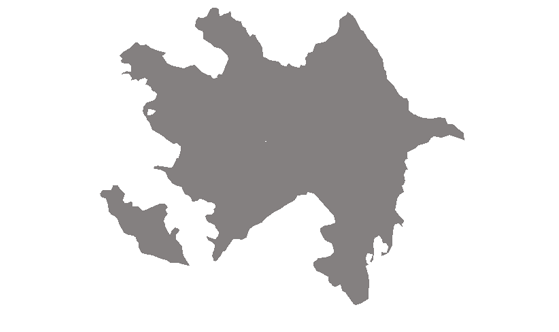
Pezeshkian Denies In Call With Aliev Iran Responsibility for Nakhchivan Drone Strike
Iranian President Masud Pezeshkian denied in a call with Azerbaijan's leader that his country was responsible for a drone attack that struck a school and airport in Azerbaijan's Nakhchivan autonomous region on March 5.
A statement on March 8 by the office of Azerbaijan's presidential office reported that Pezeshkian said "the incident involving air strike on Nakhchivan had no connection with Iran."
It addedthat the Iranian president asserted that the incident, which injured two people, would be investigated.
SEE ALSO:
'A Dangerous Situation': Azerbaijan Fears Becoming Embroiled In Widening Iran War
Baku had earlier accused Iran of firing the drones, calling it an "act of terror" and vowing to respond.
Azerbaijani President Ilham Aliyev "underlined the importance" of carrying out an investigation on the incident and also "expressed his condolences over the death of numerous civilians in the recent events in Iran," the statement said.
The drone attack has heightened concerns in Azerbaijan -- which has close military, economic, and energy ties to Israel, Tehran's archenemy -- that it could become a target of the Islamic republic's expanding response to the massive US-Israeli air campaign launched on February 28.
Iran has retaliated by firing missiles and drones at US military and diplomatic facilities and striking key energy infrastructure in the Persian Gulf. Tehran's aim, experts say, is to expand the war and increase the cost of the conflict for Washington and its allies.
Much of the concern in Azerbaijan, an oil-rich country of around 10 million people, is centered around fears that Iran could target its energy infrastructure, including pipelines and production facilities.
Azerbaijan shares an around 700-kilometer border with Iran.
Iran has long been critical of Israel's presence in Azerbaijan. Tehran has accused Baku of cooperating with Israeli intelligence -- allegations Azerbaijan denies.
Share
ShareCopy link
Facebook
X (Twitter)
LinkedIn
Email
20:38
Seventh US Service Member Dies In The War, US Military Says
Share
ShareCopy link
Facebook
X (Twitter)
LinkedIn
Email
20:13
Israeli Opposition Leader Tells RFE/RL Iran's Oil 'Lifeline' Must Be Cut
-
By
Ray Furlong
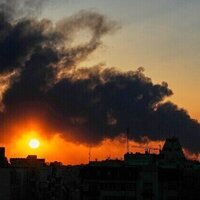
TEL AVIV -- Yair Lapid, the leader of the opposition in Israel, says air strikes on Iranian oil fields --which have showered Tehran in black rain -- were needed to cut the "lifeline of the regime" in Iran.